Subordinated loans
Fixed interest, with qualified subordination – the most common and most clearly calculable form; explained in detail under Subordinated loans.

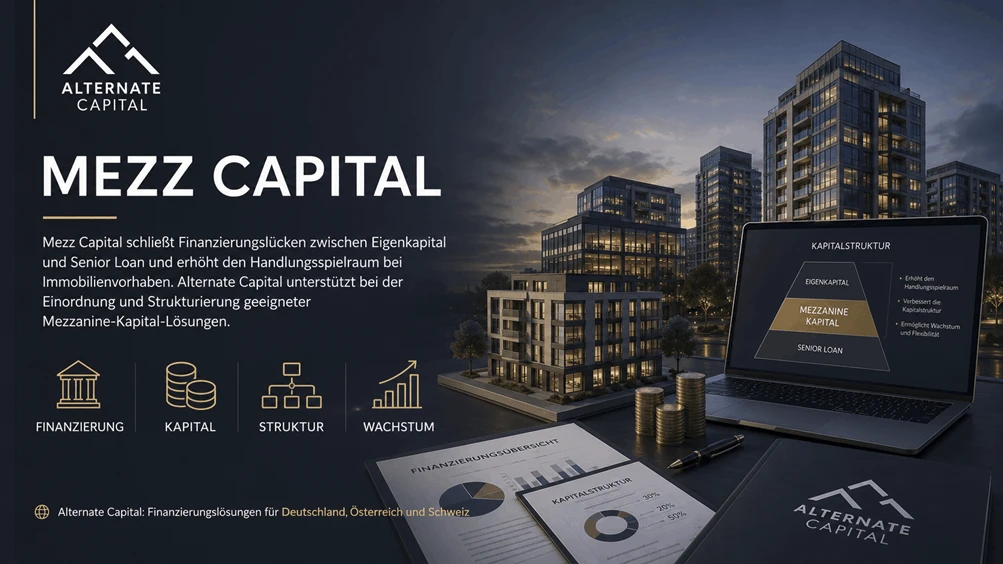
mezzanine capital is the leverage between the bank and equity for real estate: it makes projects possible that would fail at equity – against an interest rate that pays the subordinate risk. This compact briefing bundles benefits, forms, market situation and access; the detailed service page can be found at Mezzanine property finance.

Three figures explain the benefits of mezzanine capital in real estate: The bank today finances 65–75 % of the project costs. equity is the scarcest raw material of any project carrier. And the subordinate tranche closes that gap. 10–25 % of costs, which would otherwise tie up own resources.
The result is twofold: firstly, projects are possible at all whose capital requirements would otherwise be too great. Secondly, the return on equity increases because the same project profit meets less tied capital – the leverage that the calculation example uses under Mezzanine finance for developers shows in numbers. And because the capital comes as a loan, shares and voting rights remain with the project sponsors.

Fixed interest, with qualified subordination – the most common and most clearly calculable form; explained in detail under Subordinated loans.
Basic interest rate plus profit sharing: reduces the current interest burden, contributes the lenders to success – useful for high-margin projects.
Capital against participation in the project sponsors, invisible to the outside – close to equity in the balance sheet, more documentation-intensive.
Securitized claims without shareholder creation – flexible, but rather relevant for larger volumes and emissions.
Choice of form: Bank contracts, balance sheet objectives and exit determine the design. The pricing structure behind all forms explained by the guide Mezzanine interest rates.
The subordinate market has consolidated: After the turnaround in interest rates and project failures, fewer lenders draw – and the remaining ones check harder. Higher basic interest rates also raise yield expectations. For project sponsors, this means: Substance and treatment decide on access – Projects without real own funds, track record or resilient exit fail early.
The downside is an opportunity: those who request with conservative calculations, clean documents and a suitable lender selection will encounter less competition for the available capital. Which addresses currently draw and how the address succeeds, shows the page Mezzanine lenders.

Bridge and mezzanine complement each other instead of competing: The Bridge finance solves time problems (buying under pressure, bridging to bank payout), mezzanine solves equity problems. Frequent combination: The bridge secures the transaction, the subordinate tranche then leverages the project phase – or both flow into an integrated Whole loans.
For the delineation of industry inquiries: mezzanine capital also exists outside the property – the focus of Alternate Capital However, is exclusively on real estate projects in the Germany, Austria and Switzerland, where lenders, valuation and pitfalls are our craft.
Market-standard high single-digit to medium-double-digit percentage range per year – depending on the phase, leverage, collateralisation and sponsor. Bandwidths and example: Mezzanine interest rates.
Starting with €750,000 subordination requirements – under which structuring costs eat up the advantage.
Initial feedback in one to two weeks, payment on complete documents in four to eight weeks.
Substance before return: project quality, real own funds, sponsor track record and exit plausibility – only afterwards are conditions discussed.
mezzanine capital for real estate does not exist in one, but in several forms – and the choice of form influences costs, balance sheet impact and flexibility. The classic subordinated loan is clearly calculable and the most widely used. profit-participating loan with profit share lower the current interest rate, but participate the lenders in the success. Silent partnership investments are particularly close to equity, but are more documentation-intensive.
The appropriate mezzanine structure depends on the project’s cash flow. A development generating proceeds only when units are sold may suit a bullet loan with accrued interest. A rented investment property with regular income may support current interest payments. The senior bank’s requirements also matter, particularly whether it recognises the subordinated tranche as equity-like.
Our task is to choose from these possibilities the structure that fits the project, bank and exit – and to document them in such a way that neither lenders nor tax consultants ask questions later. Thus, mezzanine capital for real estate becomes a concrete, viable solution from an abstract building block.
mezzanine capital for real estate is more than a buzzword – it is a precise tool that closes the equity gap and enables projects that otherwise fail due to capital. It is crucial to choose the right shape and height for the respective project.
This is exactly where we accompany you: from the honest feasibility test to the choice of structure to the address of suitable lenders. Thus, the mezzanine capital concept for real estate becomes a concrete, sustainable financing for your project.
In summary, mezzanine capital for real estate is the right tool if a viable project can tolerate more debt capital than the bank alone provides, and the project sponsors wants to save his own funds. Whether this applies to your project, we clarify in a non-binding initial estimate – honestly and with regard to the overall structure.
Submit project, own funds and exit – we check feasibility and tranche amount and address the appropriate lenders.

Jürgen Kronawitter specialises in structured real estate finance. He helps property investors, developers and portfolio owners implement complex financing solutions. His work focuses on structuring and arranging senior loans, whole loans, mezzanine capital and bridge loans, as well as tailored financing for acquisitions, investment properties, developments and refinancing. By combining conventional bank lending with alternative capital sources, he develops financing structures for domestic and international property projects.
Jürgen Kronawitter on LinkedIn → More about the author