Close the equity gap
The bank finances 65–75 % – the subordinated loan takes over additional 10–25 % costs and protects the own funds for parallel projects.

The subordinated loan is the workhorse of structured real estate finance: it ranks behind the bank, thus acting like equity – and makes projects possible for which first-ranking financing alone is not enough. This page explains definition, use, conditions and limits.
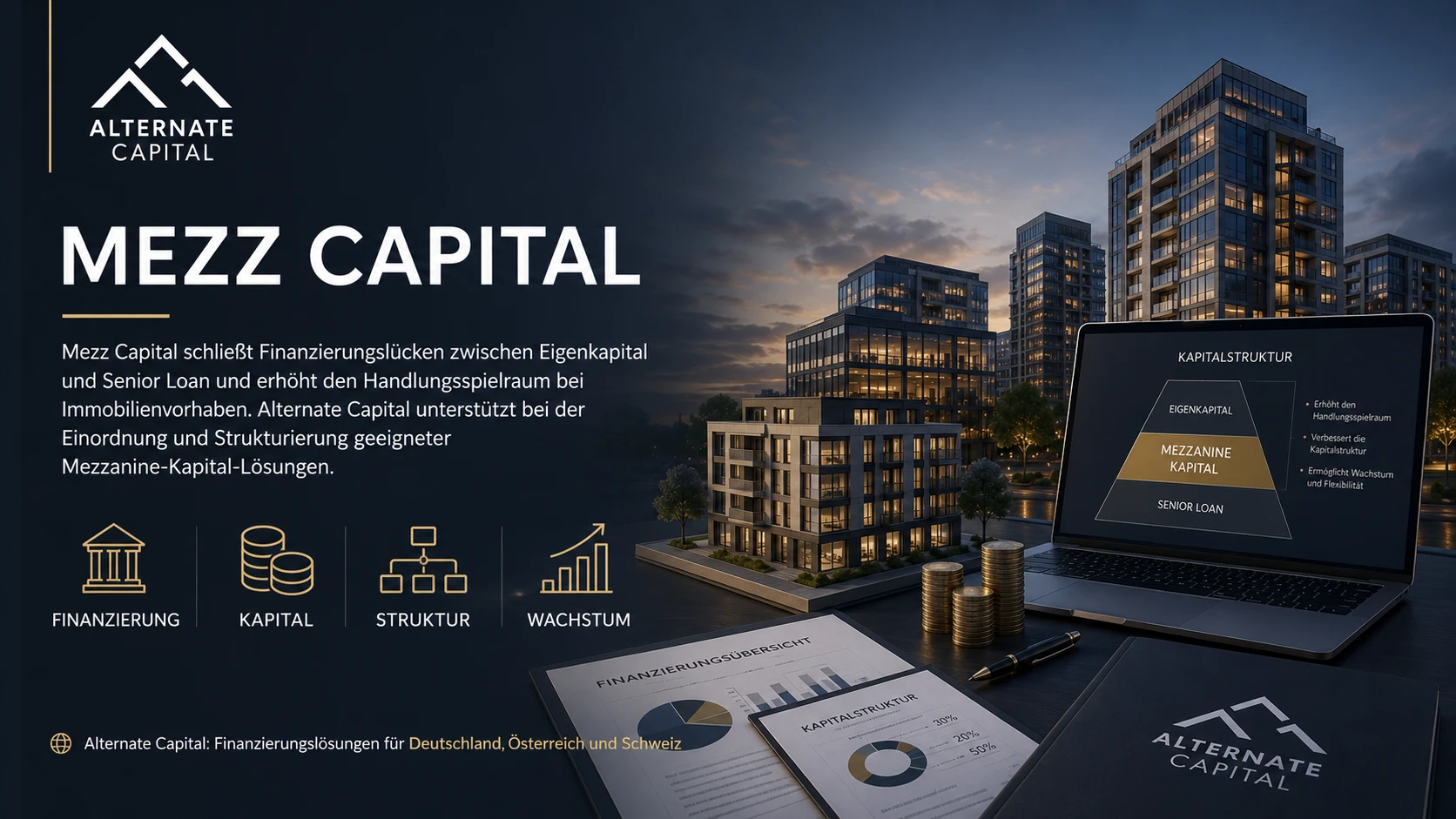
A subordinated loan is a loan with Resignation of rank: The lender declares that in the event of insolvency or liquidation, his claim will be paid only after the first-rank creditors – typically the financing bank. Frequently a Qualified Subordination, in which interest and repayment may only be paid in addition, if this does not result in insolvency.
Subordination is what gives the instrument its particular role. From the bank’s perspective, the subordinated tranche acts Economical like equity – it improves the loan-to-value structure and enables higher total financing. Legally, it remains debt capital with fixed interest and term, without voting rights and without dilution of profits for the project sponsors.
In real estate practice, the subordinated loan is the most common form of Mezzanine capital – Secured by subordinated land charge, equity pledges or purely contractual. Related special forms such as the profit-participating loan (with profit sharing) treat their own guides.

The bank finances 65–75 % – the subordinated loan takes over additional 10–25 % costs and protects the own funds for parallel projects.
Where banks are cautious, subordinated capital finances the phase until approval – after which project financing is replaced.
Borrowing capacity activated without touching the existing bank – the core case of the Additional borrowing.
Combined with Property development finance decreases the use of own funds per project – the growth lever for property developers.
Share acquisitions, hereditary disputes, bridging and selling – wherever subordinated capital is quickly needed.
A credible subordinated loan still requires genuine own funds, a viable project and a plausible exit. Risk can be priced, but it cannot be eliminated by structuring alone.
The subordination has its price: market normal is the interest Significantly above the first grade loan – in the high single-digit to mid-double-digit percentage range per year, depending on project phase, leverage, collateralisation, duration and sponsor quality. Depending on the lenders, there are also structuring fees and partly success-dependent components.
The bandwidths, all cost components and a calculation example, why "expensive" subordinated capital still pays off, can be found in the guide Mezzanine interest rates. The short version: The decisive factor is never the isolated interest rate, but the mixed calculation of the overall structure – and the leverage on your return on equity. In-depth financial knowledge beyond the property bundles our portal finanzweitblick.de.
Typical configuration: Tranches starting at €750,000, maturities 12–48 months, repayment due on sale or refinancing, collateralisation via subordinated land charge or share pledging.

When first-ranking financing and subordinated loan come together, coordination costs arise: two lenders, two exams, one intercreditor agreement. The Whole loans This is solved by placing both layers in financing with a lender bundles – up to approximately 85–90 % of the total costs, with blended rate between bank and subordinate level.
The choice is a calculation example: the separate structure (Bank + subordinated loan) is often cheaper on a quiet schedule; the Whole Loan wins at time pressure, complex phases and if the bank is limited in the leverage. We put both variants for your project side by side – with real term sheets instead of theoretical values.
How subordinated capital saves projects that depend on the equity ratio – with practical examples.
Original recording in German.
All episodes in the Podcast hub
Original recording in German.
Legally debt capital, it has an economic effect through the subordination to the bank like equity – therefore it improves the financing structure without costing shares or voting rights.
The bank does not have to “agree” to the subordination – but credit agreements often contain reporting obligations or debt limits. We review the Treaties and coordinate communication before conflicts arise.
For complete documents, initial feedback in one to two weeks is common, payouts in four to eight weeks depending on the collateral.
The subordinated lender is paid after the bank and may receive nothing. That is why lenders examine asset quality and the exit closely, and why subordinated debt carries a higher interest rate.
No – our focus is on professional real estate projects starting with €750,000 capital requirements. Crowdinvesting products for retail investors are another business with different risks.
Not every subordinated loan is the same – and the concrete design determines the legal and tax effects. The most important difference lies between the simple and the qualified subordination. In the case of a simple subordination, the lender merely resigns behind other creditors. In the case of qualified subordination, he waives in addition to demand interest and repayment, as long as this would result in insolvency of the borrower.
This distinction is not a legal detail, but has tangible consequences. Only the qualified subordination prevents the subordinated loan from being included as a liability in the over-indebtedness test in the crisis – a central point if the loan is to have an economic effect like equity. For the financing bank, this is often the condition for it to recognise the subordinated tranche as equity-like at all and to base its own financing on it.
The interest structure also needs careful consideration. Interest on a subordinated loan can be paid regularly, accrued until maturity or supplemented by a performance-related component. Accruing interest preserves liquidity during the project but increases the amount due at maturity. The appropriate approach depends on cash flow: a development relying on future sales differs from an investment property generating regular rent. We align ranking, interest and security with the project and senior financing, supported by clear documentation.
Submit key data on the project, own funds and exit – we honestly tell you whether and under which conditions a subordinated loan can be displayed.

Jürgen Kronawitter specialises in structured real estate finance. He helps property investors, developers and portfolio owners implement complex financing solutions. His work focuses on structuring and arranging senior loans, whole loans, mezzanine capital and bridge loans, as well as tailored financing for acquisitions, investment properties, developments and refinancing. By combining conventional bank lending with alternative capital sources, he develops financing structures for domestic and international property projects.
Jürgen Kronawitter on LinkedIn → More about the author