Project stage
Land without planning permission is generally more expensive to finance than permitted construction. Nearly completed projects with some units already sold tend to attract lower-cost tranches.

Mezzanine interest rates are a frequent question, but a single figure rarely provides a meaningful answer. This guide explains indicative ranges, cost components and the factors that can improve a project’s financing terms.

The rise in interest rates has changed financing costs. Risk-free rates increased while banks adopted more conservative leverage, sustaining demand for subordinated capital. For sound property projects with experienced sponsors, total annual interest costs typically fall between high single-digit and mid double-digit percentages.
The wide range reflects different risk profiles. A short-term tranche secured by a subordinated land charge against a substantially presold Munich residential development differs from unsecured finance for land without planning permission in a secondary location. A fixed rate quoted without assessing the project cannot reflect those differences.
Important: These figures are market observations rather than commitments. The terms available for your project follow a review and discussions with suitable lenders.
Land without planning permission is generally more expensive to finance than permitted construction. Nearly completed projects with some units already sold tend to attract lower-cost tranches.
Higher total leverage, including subordinated debt, increases the lender’s exposure. Additional leverage therefore affects the margin.
A subordinated land charge, share pledge or guarantee can improve the lender’s security and reduce pricing compared with purely contractual subordination.
Short terms with a clear, documented exit through sale or refinancing are generally less expensive than an uncertain horizon relying on extensions.
Track record, the equity contribution and transparent financial information can strengthen the sponsor’s negotiating position.
Liquid residential locations generally offer stronger security than specialist assets in peripheral markets, because lenders must consider realisation in a downside scenario.
Debt funds, family offices and insurers have different return targets and risk appetites. Selecting a lender whose criteria fit the project can influence pricing.
Compare every cost component on an effective annual basis. A low headline rate can be offset by higher fees and other charges.
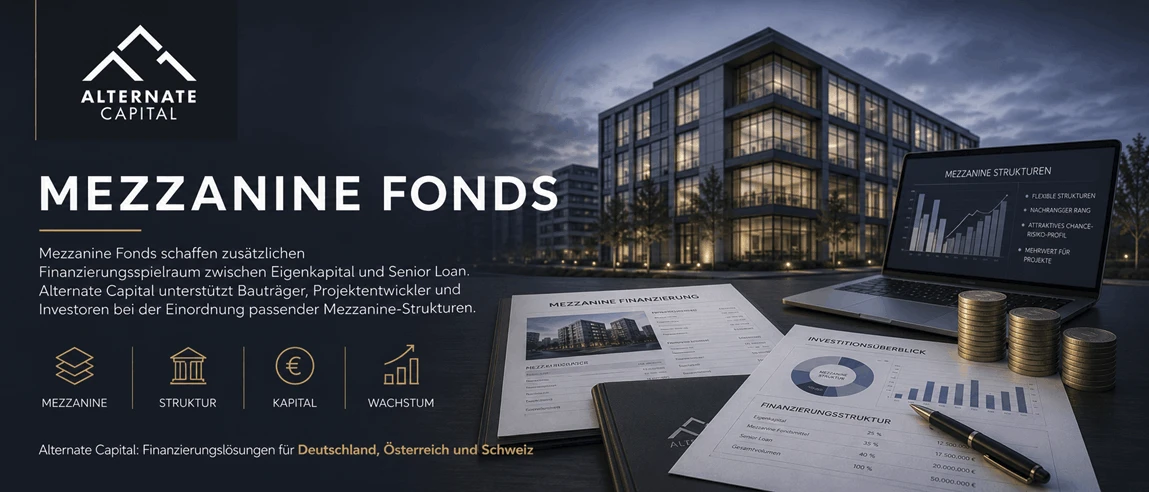
| Location | Without mezzanine | With mezzanine |
|---|---|---|
| Total project costs | €10.0 million | €10.0 million |
| Senior bank loan | €7.0 million | €7.0 million |
| Mezzanine tranche | – | €2.0 million |
| Own funds | €3.0 million | €1.0 million |
| Assumed project profit | €1.5 million | €1.5 million less mezzanine costs |
| Return on equity | 50 % | Potentially higher despite the interest cost — with €2 million available for another project |
Simplified example excluding taxes and transaction costs; no promised return. Leverage works in both directions, so each structure should be assessed conservatively and under stress scenarios.
Retaining funds for other projects · enabling a larger project without new shareholders · retaining voting control · implementation alongside existing bank finance · potential improvement in equity returns.
Higher costs than bank finance · a repayment obligation at maturity · reporting requirements · greater losses if the project underperforms · an equity kicker reducing profit retained on success.
Rule of thumb: Mezzanine capital can make sense where the improvement in return on invested equity exceeds the additional financing costs and a credible alternative repayment plan exists. We assess both before structuring a tranche. Further reading: Advantages and disadvantages of mezzanine capital and Mezzanine finance compared with bank loans.
The pricing structure explained in audio, with examples from financing practice.
Original recording in German.
All episodes in the Podcast hub
Original recording in German.
Interest on a subordinated loan incurred for business purposes is generally a business expense. Your tax adviser must confirm the treatment, including any interest deduction limitations.
Yes. Moving from purely contractual subordination to a subordinated land charge can have a significant pricing effect, sometimes amounting to several percentage points.
Yes. An existing term sheet provides a useful benchmark. Introducing another suitable lender can create competition and improve the negotiating position.
Minimum interest periods of 6–12 months are common. Where the funding requirement is expected to be short, we negotiate the clause specifically or consider Bridge finance.
Mezzanine pricing reflects the lender’s risk assessment. Reducing identifiable risk can improve the terms. Discussions are therefore more effective when they address the underlying risk factors alongside the price.
Security is particularly important. A subordinated land charge gives the lender a tangible security interest and can reduce pricing compared with purely contractual subordination. A sponsor guarantee or share pledge may also help. Transparency is another factor: complete, professionally prepared financial information and sensitivity analyses reduce uncertainty for the lender.
The term and exit also matter. A short term with documented repayment through existing sales or approved follow-on finance differs from an uncertain exit. Finally, lender selection is important. We approach providers whose investment criteria fit the project, creating relevant competition rather than relying on an unsuitable source.
Send us the project details for a candid assessment of a realistic pricing range and the factors that could improve it.

Jürgen Kronawitter specialises in structured real estate finance. He helps property investors, developers and portfolio owners implement complex financing solutions. His work focuses on structuring and arranging senior loans, whole loans, mezzanine capital and bridge loans, as well as tailored financing for acquisitions, investment properties, developments and refinancing. By combining conventional bank lending with alternative capital sources, he develops financing structures for domestic and international property projects.
Jürgen Kronawitter on LinkedIn → More about the author